
5 Sanity-Saving Habits for Christian Writers
Balancing writing life and motherhood is no easy task. Don’t get me wrong, I love my family. But when I’m knee deep in drafting battle scenes, the last thing I want to hear is: “Hey, Mom, what’s for dinner?”
I know you can relate. You’re my people. You get it.
Thankfully, this journey with Christ has taught me many lessons. Among them are tips and habits that help me build this beautiful writing career while serving my family and keeping my sanity.
How Christian Writers Can Stay Sane When Life Feels Overwhelming
If you’ve been looking for ways to cultivate peace while managing family responsibilities and business goals, all while not screaming into the void or pretending your husband’s face is the dish you’re scrubbing, then sit tight. I have five practical and easily implemented tips to help you stay on track, serve your family, find peace, and avoid losing your ever-loving mind.
Our first tip today will feel like a no-brainer and an almost expected tip. However, please don’t allow the familiarity of the tip cause you to discredit the value, beauty, freedom, and peace that comes with it.
Tip 1: Spend Time With God
In order not to be tossed to-and-fro like the Word talks about in Ephesians 4, or to have a gentle and quiet spirit like in 1 Peter 3:4, we need a foundation that is unshakable, unbreakable, and unmovable.
That type of emotional, mental, and spiritual stability can only be made by the hands of God, and it isn’t something completed overnight. There is a process—or a journey, if you will—that Jesus will take us through to address the root causes of our overwhelm, emotional fatigue, short tempers, etc.
Why Time with God Is Non-Negotiable for Christian Writers
Sometimes, the very things causing us to lose peace, joy, and hope throughout the day are deeper than simple surface-level problems.
And in His lovingkindness, the Lord doesn’t want you to stay in those unhealthy mindsets and rhythms, and so He will invite you to walk deeply with Him to address the root causes, leading you to wholeness and true freedom in Him. That way, you can have that solid, stable, and unshakable foundation.
Those types of journeys with Jesus take time. Which makes spending time with God a non-negotiable.
When we cultivate that intimate space with God, the place of raw vulnerability, we also position ourselves for the type of transformation our hearts truly long for.
If you want more peace, more patience, more calm, or clearer creativity, it is all found in God’s presence.
Often, in the process of walking out God’s will for our lives, our gaze can shift. We get so focused on being good stewards and faithful servants that we lose sight of the key fact that we are also daughters.
And there is something transformational that takes place in our prayer time when we come before the Father as a daughter.
Give God Your First and Best — Not Your Leftovers
God is pleased with our faith and our obedience. But problem-solving sales strategies and untangling tricky plot lines aren’t the only things He wants to help you with. Yes, having Him as the CEO of your writing business is fantastic. But He isn’t just the CEO relegated to certain office hours, He’s your father in the everydays and the in-betweens.
Give Him the time and space in your daily schedule to let Him love you, feed you, encourage you, inspire you, etc.
This world is too hard to try to endure it without Him. Oh, believe me, I’ve tried. I tried to build this writing career the way I thought it should be built. I worked hard and strived to be the best at everything I put my hands to, whether that was ministry, motherhood, or entrepreneurship. Everything I built within my own power only left me empty, broken, and spiritually dead.
But thanks be to God that even in my sin and my shame, He saw someone worth saving. I have learned through the hard battles that I cannot do this without Him. But it’s from a place of love and truly knowing Him that I choose not to do this life without Him.
How to Build a Consistent Prayer Rhythm in Busy Seasons
Now, all that aside, here are some ways that we can implement daily time with God to cultivate peace and save our sanity.
You are going to know your schedule best. However, I do recommend blocking out alone time either before anyone else is up or before the heat of your day starts.
I know some people will argue and say they aren’t morning people and they’d rather do devotions in the afternoon or evening and call it good.
My friend, I love you. I respect you. But if you want strength and peace for the day, you’re gonna have to sit with the Father before the heat of your day starts. Squeezing in a quick 5-minute devotional when you can manage it isn’t gonna to lead to deep transformation.
If your spouse, child, or family member only spent the equivalent of a 5-minute drive-by with you, how strong would your relationship be? It’d be pretty weak and flimsy, right?
Sacrifice a bit of your comfort for an early morning soak in the Holy Spirit. Read scripture, journal, praise, worship, and pray without ceasing, faith-believing that God cares, He loves you, and He meets you in that beautiful space.
Quick side note for those with infants: Those in early motherhood often don’t know if they’re coming or going. I see you, beloved. If that’s you, then ask the Lord to help you establish a consistent rhythm where you give Him your first and best and not just your leftovers. You’re going to need the strength that only He can give you.
Another way to implement daily time with God is to cling to the words He gives you. This will keep Him top of mind and present with you as you go on about your day.
Social media scrolling and the artificial dopamine hits from your phone will not sustain your heart. God, His Word, and His Holy Spirit will be what truly carries you through.
Plus, ruminating on scripture keeps you from ruminating on the problems that feed anxiety. It also cultivates ongoing peace and patience, refreshing your spirit and making you less snappy. Trust me on this.
Everything else we’re about to talk today about flows from this place right here. These next four tips work best when our foundation has been established through time with Him.
We got a bit deep going over our first sanity-saving tip. It was good, needful, and will serve as that amazing foundation. Our next tip, however, will help us have fun.
Tip 2: Give Yourself Time for a Clear Mind with Busy Hands Break
As creative entrepreneurs, there are so many different aspects of business that we need to learn. Regardless of whether we take the indie road or traditionally publish, we need to treat our writing careers as a business.
Which means we’re learning all the things. From website SEO to effective newsletter campaigns, to Amazon ads, and even digesting new marketing trends for reader engagement, the influx of information can become crazy overwhelming. Especially if it’s stretching you outside of your comfort zones and realms of genius.
And if we’re not careful, the ingestion of education and information will lead straight into an overwhelm-spiral.
Which, for me, includes my senses being overstimulated as well. I don’t know if that happens to you or if it’s just a weird brain thing for me. But if I get mentally overwhelmed, I need to calm the sensory triggers around me, too.
As you can imagine, that’s where our second tip of clear minds with busy hands came from.
Studies show repetitive hand motions help regulate the nervous system and lower stress responses.
Guess what also gets unclogged in the process? Yep, your creative well.
I’ve seen a resurgence in what many call the “grandma hobbies” like gardening, crochet, knitting, and even baking sourdough. And this isn’t just with women my age.
My daughter has always loved doing crafts. She took up crocheting a few years ago but recently discovered that if she crochets for a few minutes before bed, while listening to praise and worship music, she inevitably sleeps better.
I’m telling you, my friend, giving your brain the chance to take a break while keeping your hands busy will help you keep your sanity.
Real quick: I know hand-related chores like dishes, meal prep, or folding laundry could arguably fall into this category. But who in their right mind chooses those as their distressing activity? We want to save our sanity, not stretch it thinner.
Simple 10-Minute Creative Break Ideas
So if you start feeling overwhelm creep in, take a clear mind with busy hands break. You would be surprised by what you can accomplish in 10 minutes. So don’t make the excuse that you don’t have time.
If you’re stumped and don’t know what to put your hands to, here are a couple of suggestions that our household loves. Each of these can also be done easily in 10 minutes.
- painting (watercolors or acrylics). We already have our paint palettes assembled and supplies in a craft cart. So all we have to do is grab some fresh water and dive in for an easy break.
- As I mentioned before, my daughter crochets. It would be hard to finish a full project in 10 minutes—unless it was a small one. However, 10 minutes of crocheting will still give you that helpful mental break.
- Some other things could be coloring or sketching.
- or woodworking, assembling a puzzle, etc.
- A 10-minute walk would be helpful, but I’ll chat about that in a different tip.
A few other recommendations for when you have longer than 10 minutes.
- Bread making — this is a sensory thing for me, but the feel of dough in your hands is magical.
- Gardening — again, I’ll chat about this in a different tip; however, it’s still good to mention here
Those are just a few suggestions to get your ideas percolating. Find something you enjoy doing with your hands that will also give your mind a break. Your overall well-being and creative health will thank you.
Believe me, you’re going to want to keep this tip in mind, because it never fails that when I give myself a mind break, that’s when the creative well unclogs and in flows fresh words for either my current draft, marketing copy, or podcast script ideas.
Life feels much more manageable when my mind is clear. And I never fail to have an influx of fresh ideas for whatever problem I’m facing.
Our next tip is going to lean more into planning ahead and how we structure our overall rhythms.
Tip 3: Embrace Unconventional Scheduling
I’ve talked a lot about having a healthy relationship with time on the podcast. It goes back into those deeper conversations we have with the Lord, where He uproots the hidden issues, not just the surface-level problems.
When we have a healthy relationship with time, we learn that time is a resource to be used and managed. But the way I use time doesn’t necessarily have to be in the same way another writer uses theirs.
For example: I’ve been experimenting with what’ve I’ve dubbed as an ‘unconventional’ schedule. I’ll explain what I’ve done in a second, but let me break down how the experiment came about.
Why Traditional Productivity Systems Don’t Work for Every Writer
I have very little time in my time bank each week, and so I need to use those time blocks strategically for the things that actually move my business forward.
Quick note: I’ve done the prerequisites of sitting with the Lord and have a clear understanding of what my priorities are for both my writing business and my family. There is no confusion in what my quarterly goals are and how they need to be broken down each month.
My struggle, however, was in the daily and weekly rhythms. Finding that sweet spot in the systems I created to help me have consistent output for that sustainable business growth.
You already know I’m a productivity junky, so I’ve tested all sorts of daily and weekly schedules, systems, routines … you name it, I’ve probably already given it a shot.
But I struggled to keep a sustainable rhythm that worked with my brain.
My beautiful brain is great at hyper-focusing, where I can tune out the world and zero in on a given task, whether that’s drafting my own stories, editing for clients, or ingesting education on new marketing trends.
The capability to hyper-focus is both a superpower and a weakness all rolled into one.
For the longest time, I would try to break up my dailies using AM time blocks for certain tasks, then switch directions after lunch, utilizing my afternoon time blocks for another avenue of the business.
That routine failed me because my brain would fixate on what I had started in the AM, causing my afternoon time blocks to fizzle out and be wasted. I had the same problem with themed days. If I didn’t finish a certain project earlier in the week, my brain wouldn’t let up until I got it done. I’d struggled to focus on anything else. Once that hyper-focus latched onto something, it was like a dog with a fresh bone.
My Unconventional Writing Rotations
So instead of fighting against how my brain was wired, I leaned into it and made a customized schedule that made sense for me. It’s unconventional, and I haven’t seen it taught anywhere else. But it works for me.
p.s. I totally give credit to the Lord for the idea. The lightbulb moment seemingly came out of nowhere during one of those clear mind with busy hands rest breaks. (wink, wink; I couldn’t resist that plug for the previous tip).
And because I’m sure you’ll be curious about what my unconventional schedule (air quotes) looks like, here’s a quick rundown of the rhythm I’ve been using for the past 4 months.
Mondays — home admin and/or weekly reset, depending on what’s going on in life. I clean, brainstorm that week’s menu, all the things for home or family.
Tuesdays through Thursdays — are project days. These are the designated time blocks I give my brain permission to flex its superpower. More on this in just a sec.
Fridays — rotate like flex days I remember from high school. Most Fridays, I’m planning school schedules for the following week, filing or grading papers, general home admin, and I sprinkle in work admin as the week demands.
- Mondays — home admin and/or weekly reset, depending on what’s going on in life. I clean, brainstorm that week’s menu, all the things for home or family.
- Tuesdays through Thursdays — are project days. These are the designated time blocks I give my brain permission to flex its superpower. More on this in just a sec.
- Fridays — rotate like flex days I remember from high school. Most Fridays, I’m planning school schedules for the following week, filing or grading papers, general home admin, and I sprinkle in work admin as the week demands.
- Saturday — designated for home and garden projects, ministry outings, time with extended family, or simply crashing as a rest day.
- Sundays — church all day with an amazing nap in between
That is a general overview of my week, and while on the surface it looks like any other themed-day routine. But here’s where the magic kicks in.
Those three project days are on alternating rotations. Not every week’s project days are the same. Meaning of the four weeks in a month, two weeks are strictly for admin-related projects like launches, client work, marketing, taking courses to grow my education, etc. Then the other two are strictly for writing.
So instead of switching mental gears every day, I switch gears every other week.
Every priority gets the attention it needs and doesn’t have to fight for time or space in my brain. I’m able to assess my time bank, plan ahead, and manage my responsibilities effectively within healthy boundaries.
Leaning into how my brain works rather than forcing it to fit molds designed for other people has helped me increase my overall output without garnering more stress.
This is huge. Best of all, I’ve remained consistent, and this is a sustainable rhythm for me.
Now, I don’t share this sanity-saving tip for you to feel compelled to mirror my schedule, systems, or routines. I share this as a way to encourage you to think outside the box if traditional schedules aren’t working.
No one said you had to structure your writing routines based on the 9 to 5 model.
If you’re curious to see how a customized schedule could work for you, take a week or two and observe the natural rhythms that your family already operates in. You’ll be surprised to see how life ebbs and flows instinctively as you all simply live out your days.
Play around with what you discover and see how you can then optimize those natural rhythms.
Bonus: Meal Prep for Deep Writing Days
Oh, and as a quick scheduling bonus tip: if you dread the weeknight sludge of cooking dinner, make advanced meal prep your friend. I’ve done this in a couple of different ways. I’ve used Mondays to chop and prep things in advance, where all I had to do was either reheat or toss items in the pan for a quick meal.
But my favorite hack is taking a Saturday to assemble freezer meals where I either pre-measure or pre-cook a variety of meals my family already loves.
My friend, nothing feels better on a deep writing day than pulling something out of the freezer and either shoving it in the crockpot or reheating it in the oven. My family is fed, minimal effort was required by me, and I didn’t have to pull myself out of my writing block for more than 5 or 10 minutes.
A true game changer.
Whew, lots of good stuff in today’s chat. We have two more tips to dive into. I hope you’re feeling inspired.
The next tip we’re gonna dive into will feel similar to the clear mind with busy hands tip, but it does have its own distinction.
Tip 4: Get Outside and Interact With Nature
Depending on the weather and your climate, being outside may or may not sound pleasant or agreeable. However, there are so many science-backed studies proving the benefits of nature on our overall well-being, so I encourage you not to skip over this sanity-saving tip.
You’re welcome to do a quick Google search, but I’ll share a few key benefits of getting outside here:
- Spending time in nature lowers your cortisol levels (which is your stress hormone, by the way). And lowering those cortisol levels also decreases your overall stress and anxiety. So taking a quick walk, sitting on the porch with a cup of coffee, or working in your garden can lessen the sensory overload and help you recenter.
- Another benefit, exposure to sunlight triggers the release of serotonin and Vitamin D, both associated with boosting mood and focus.
- Natural environments are known to help restore attention and concentration, which often become fatigued by demanding work tasks. Being in nature has also been shown to improve working memory, creativity, and problem-solving abilities.
I know the nerd in me is showing here. But I can’t help it. There is such wonder and beauty in the world our God has created. I love that creation isn’t just beautiful, it’s restorative by design.
And isn’t it just like our Heavenly Father to use the wonders of creation to refresh us and feed our creativity?
If you’re not sold on this yet, then I’d love to extend a little challenge. Pick one day this week where the weather isn’t nuts and go outside. Feel the sun. Breathe in the fresh air. Get your hands in dirt or simply sit with a cup of coffee. Spend at least 10 or 15 minutes outside and tell me you don’t feel the difference.
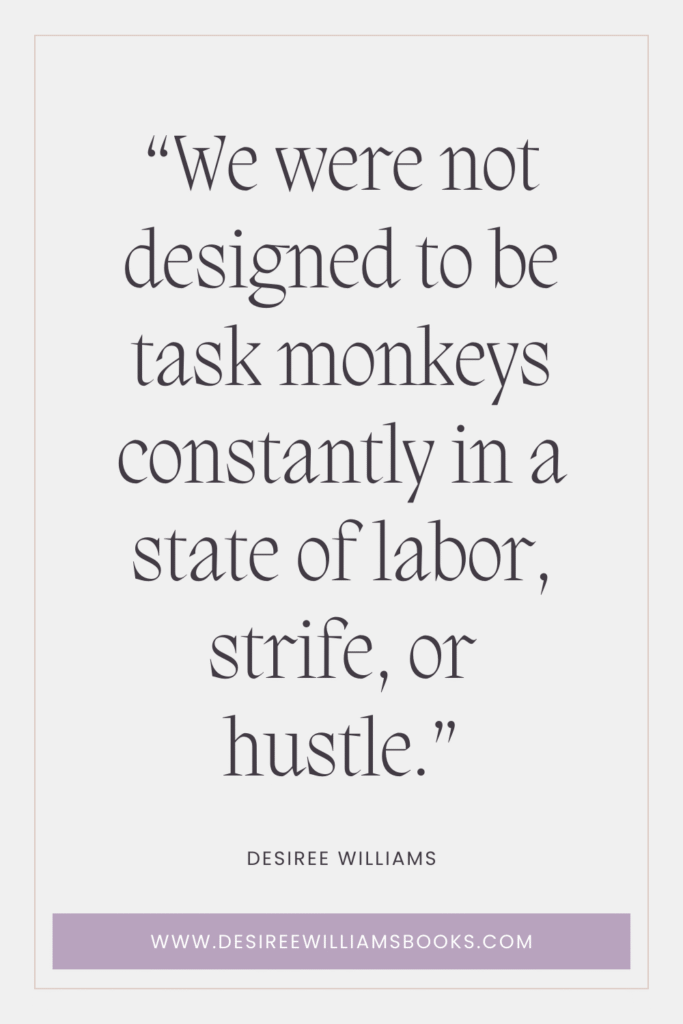
We were not designed to be task monkeys constantly in a state of labor, strife, or hustle.
Go out and live. Engage in and experience the wonders of what God has made.
And then of course come back and gush all about it to me, because I’d love to cheer on your breakthroughs.
Which segues us into our final sanity-saving tip for today.
Tip 5: Connect With Writing Friends
I’ve said it before, and I’ll keep saying it: we were not made to live in isolation, we were made for community.
And getting together with like-minded creatives to unload, share, celebrate, and cultivate together can be a great way to refresh your heart, reignite your creativity, and soothe your mind in this crazy world.
Commenting on someone’s post on social media doesn’t equate to a true connection. That might be a way to knock on the virtual door, but you need to sit down with fellow writers.
Where to Find Christian Writing Community
A few ways to facilitate this is checking online for local writers group. ACFW (American Christian Fiction Writers) has chapters spread far and wide. The chapter in our region meets in two location, plus online. So lots of opportunities to connect.
You could also check your local library. Sometimes they’ll do author meet ups. I even taught a class for fellow writers at our local library a few years back.
Reaching out to someone you met at a writers conference is great too. If they’re local, invite them out for a cup of coffee if lunch feels too intimidating.
If you can’t meet in person, then hop on a video call for an hour or so.
When we study the life of Jesus, what do we see Him doing most with His disciples? We see Him sitting, dining, talking, teaching, and fellowshipping with them. He connected with them through conversation.
Not only does the Lord want to do that same thing with us now, but we can also utilize that same standard to build connections with other writers.
How Community Inspires Encouragement
Carving out time for community reminds us that we are not alone.
Even 1 Peter 5:9 reminds us that the hardships, pain, sorrows, and trials that we’re facing are also being faced by those of the faith around the world. We are not alone, even in our sufferings.
Life always feels brighter when things are going well. It’s in the hard and dark times when we feel the loneliest. But we need to stir up our faith and remember that in any situation we go through, there is always someone walking with us.
And if you’re mentally arguing with me right now, still thinking that there’s no one you can turn to, prove yourself wrong by sending me an email. I’ve shared since the beginning of this podcast journey that I am for you. I champion you and am continuously cheering you on.
If you need a safe place to unburden your shoulders, then hit up my inbox. I’d love to extend a virtual hug.
God is always with you, and I’m right here, cheering for your success.
Final Encouragement for the Overwhelmed Christian Writer
Wow, we covered a lot of ground today. I pray one of these tips struck a cord of inspiration within your heart, and you’re walking away refreshed and revived.
As a quick wrap-up, here is a recap of our sanity-saving tips for today:
- Tip 1: Spend Time With God
- Tip 2: Give Yourself Time for a Clear Mind with Busy Hands Break
- Tip 3: Embrace Unconventional Scheduling
- Tip 4: Get Outside and Interact With Nature
- Tip 5: Connect With Writing Friends
My friend, you are a gem, and I’m so glad you stopped in for today’s chat.
If you have any questions or would like to continue the conversation, don’t hesitate to reach out.
And if this blessed you, please consider sharing this post so that other amazing writers like you can discover the encouragement found here.
Until next time, my friend. Happy writing and enjoy the journey.

February 20, 2026









Be the first to comment